Web3 Payment Gateway: Global Crypto Acquiring & Clearing Infrastructure
As global digital asset infrastructure gains widespread adoption, stablecoins have emerged as an indispensable, high-success-rate settlement alternative alongside credit cards, Stripe, and Local Payment Methods (LPMs) for expanding digital enterprises and cross-border platforms.
DogPay Web3 Payment Gateway delivers a native crypto acquiring and clearing API infrastructure built for global digital platforms, AI SaaS, gaming entertainment, and cross-border businesses. Merchants can deploy an anti-risk, low-latency Web3 checkout supporting seamless global user payments without building complex blockchain node infrastructure or handling heterogeneous cross-chain communication.
Gateway Definition: What is DogPay Web3 Acquiring?
DogPay Web3 Payment Gateway is a crypto acquiring infrastructure built for digital platforms, AI entertainment, gaming, content subscriptions, creator platforms, and cross-border businesses.
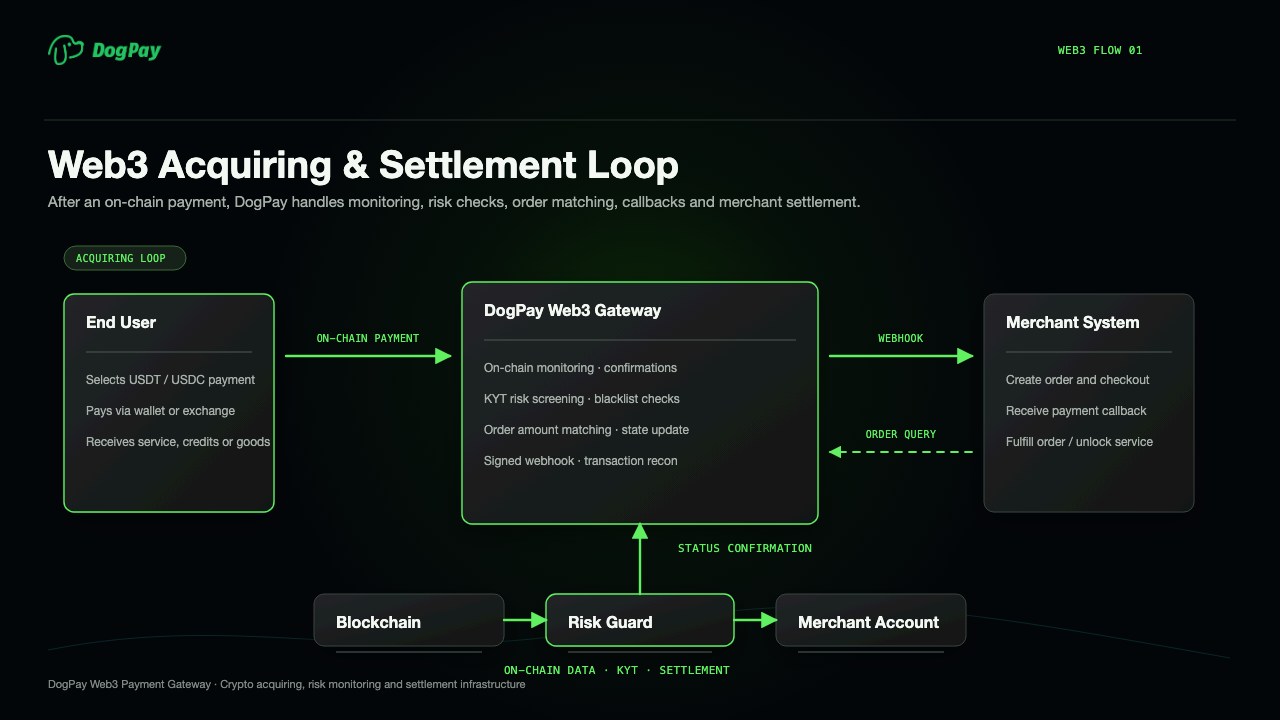
Through APIs or ready-to-use checkout URLs, merchants can instantly activate crypto payment options centered around USDT / USDC. Once a user completes an on-chain transfer, DogPay automatically triggers an end-to-end clearing and information loop (The Web3 Acquiring Loop):
Tactical Target Segments: Typical Use Cases
Crypto acquiring provides a high-efficiency solution to overcome traditional financial friction, such as high chargeback rates and limited geographical coverage:
AI Wave & Digital Subscriptions (AI & Digital SaaS): High-frequency subscription renewals for AI video generation, AI content tools, AI Companions, and utility SaaS products.
Global Gaming & Virtual Assets (Gaming & Virtual Goods): Instant settlement for international game coins, point purchases, virtual props, and in-game skin assets.
Private Content & Creator Economy: Independent creator platforms, overseas private community memberships, e-books, and digital art sales.
Edge Cross-Border Corridors (High-Risk & Low-Success Corridors): For overseas regions where traditional credit cards suffer high rejection or low issuance success rates, USDT/USDC provides 100% on-chain payment certainty.
Core Technical Arsenal: Gateway Capability Suite
DogPay encapsulates complex distributed ledger technology into mature, merchant-grade acquiring tools:
Unified Checkout UX: Provides hosted checkout pages (Hosted Checkout) or generates dedicated payment addresses / dynamic payment links via API.
Automated On-Chain Ledger: Distributed network nodes listen to fund movements in real time, automatically matching orders based on代币 token type, target address, and required block confirmations.
Merchant Ledger & Reporting (Reconciliation Engine): The merchant dashboard provides clear transaction logs, order status tracking, fee deduction breakdowns, and one-click structured report exports.
Clearing, FX & Risk Defense (Settlement & KYT Guard): Fully integrated high-value transaction monitoring and blacklist screening, supporting native stablecoin settlement, reverse fiat exchange, and compliant cross-border Payouts (disbursements).
The Acquiring Loop: Standard Workflow Diagram
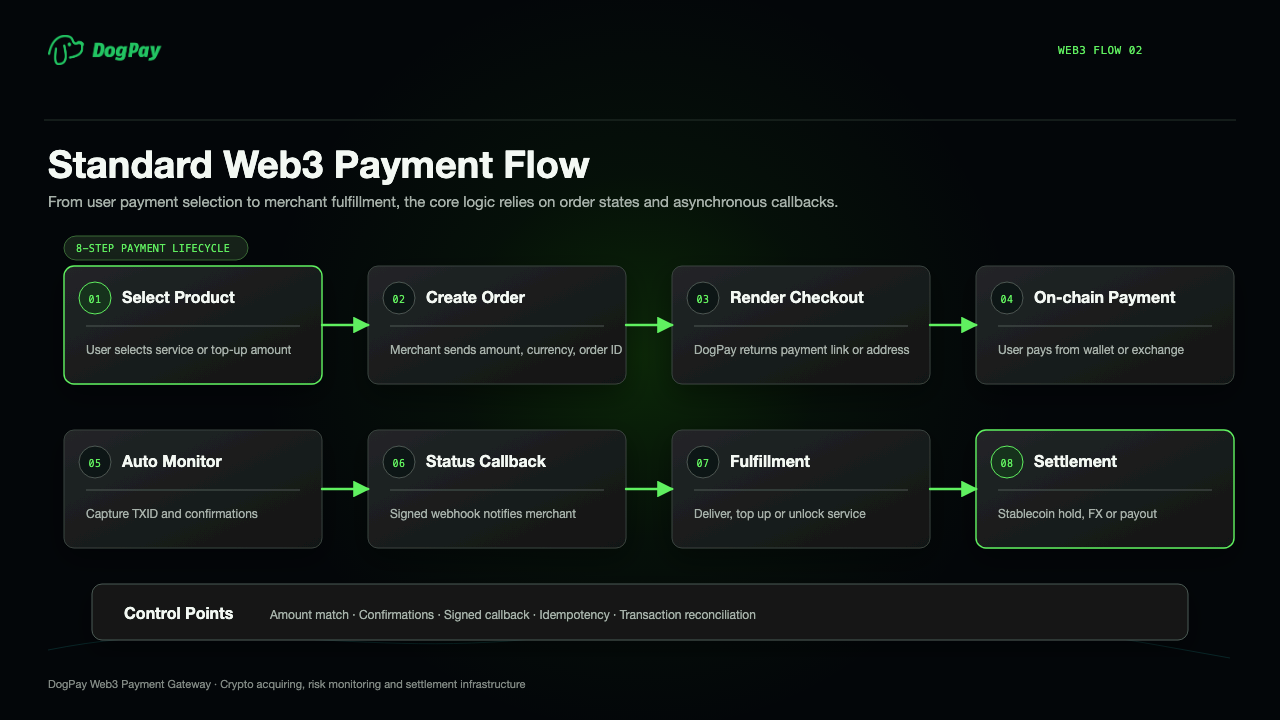
The complete acquiring and fulfillment workflow is structured into eight standardized steps, executing automated merchant fulfillment via asynchronous callbacks:
Standard Onboarding Prerequisites: Onboarding Checklist
Before submitting a gateway integration request for live production, please ensure your team has prepared the following foundational compliance and technical metadata:
💡 Merchant Onboarding Checklist:
Basic Documentation: Legal merchant corporate entity credentials, active business website URL or App download links, detailed product/service model overview.
Business Model: Projected monthly transaction volume, required acquiring token networks, and target settlement currencies.
Technical Parameters: High-availability production Webhook listener URL and a designated technical point of contact.
Note: If your business involves sensitive industries, multi-party collection/payouts, or complex platform-level sub-account splits, the DogPay compliance team may request additional business disclosures or risk materials.
Developer Integration Guide: API Integration & Workflow
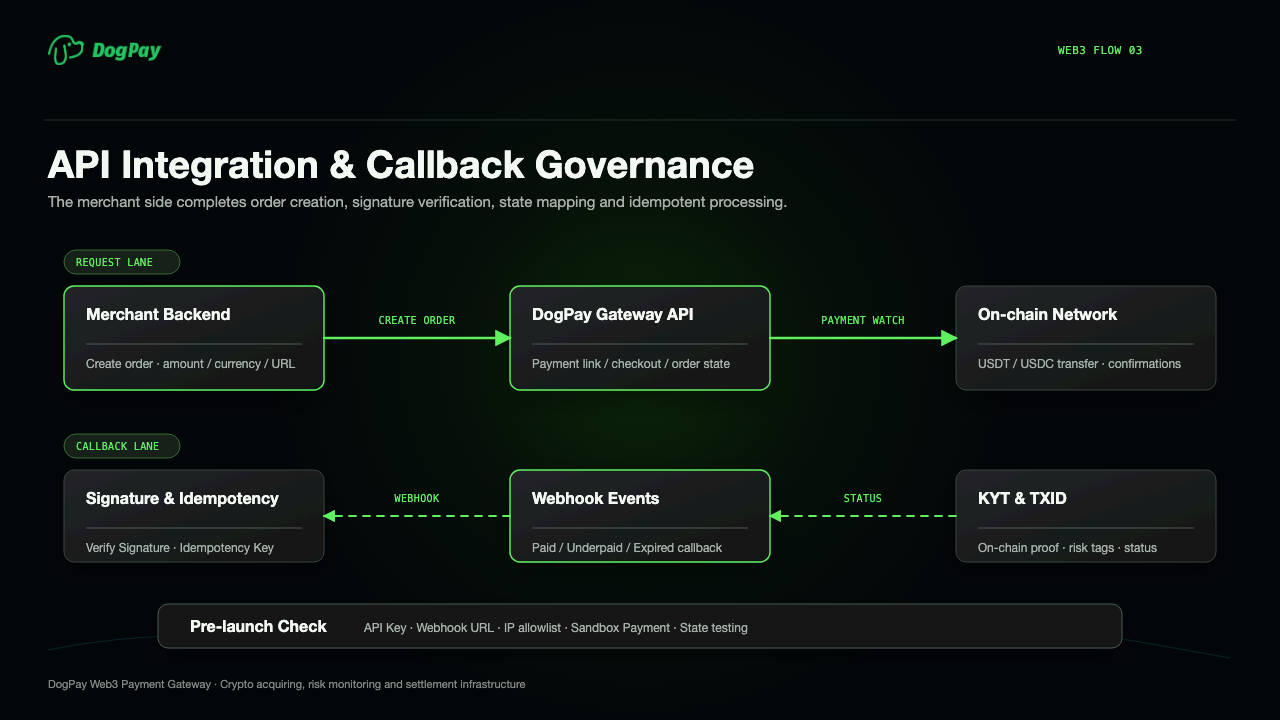
Merchant development teams can rapidly complete business logic integration using our unified Web3 Gateway API.
1. Step-by-Step API Integration Workflow
2. Merchant Risk Control SOP
⚠️ Strict Webhook Handling Rules:
Signature Verification First: Upon receiving a callback, immediately verify the
signatureusing DogPay’s public key to prevent phishing attacks.Amount Hard Validation: Strictly compare the
pay_amountin the payload against the expected receivable amount in your internal database.Idempotency Design: The merchant webhook endpoint must enforce strict idempotency logic (using
dogpay_order_idormerchant_order_idas a unique primary key). Network retries from DogPay must never cause duplicate fulfillment, double crediting, or redundant accounting entries.
Operational Risk Control: Anti-Money Laundering & KYT Guard
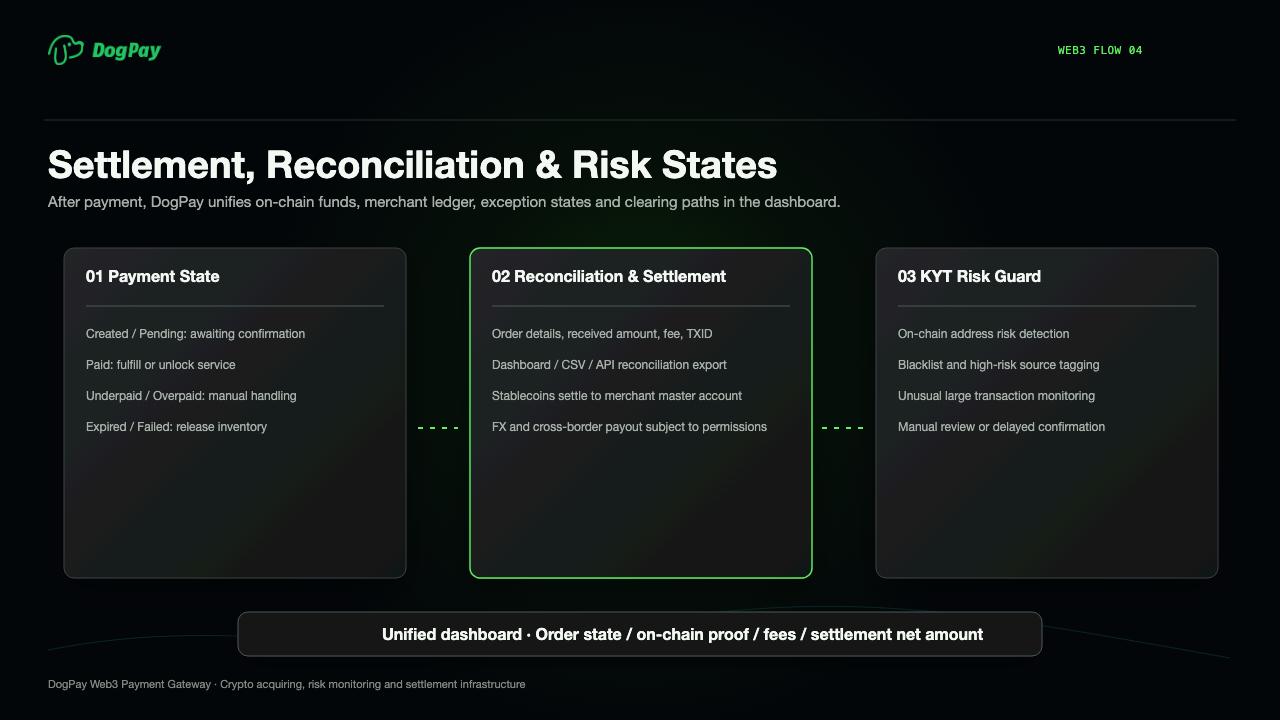
To shield merchants from exposure to illicit or tainted on-chain assets, DogPay deploys an automated On-Chain KYT Defense Layer (The Risk Guard):
Real-time KYT (Know Your Transaction) Screening: Evaluates all inbound wallet addresses at the entry level, automatically blocking or tagging funds originating from coin mixers, darknet markets, or sanctioned entities.
Blacklist Address Interception: Dynamically linked with global blockchain compliance databases, executing second-level halts or manual holds on transactions originating from blacklisted addresses.
Anomalous Volume Monitoring: Automated hold cycles are triggered on sudden, out-of-pattern high-value fund inflows to ensure complete regulatory compliance.
Frequently Asked Questions
1. Can Web3 Payment Gateway completely replace Stripe?
Not necessarily. In global cross-border operations, we recommend using DogPay as a strategic complement to Stripe and traditional credit card rails. When users lack credit cards or face frequent risk declines on international cards, offering a stablecoin checkout option instantly recovers lost conversion opportunities.
2. Does the end user need a crypto wallet during checkout?
Yes. Since this is native on-chain acquiring, end users complete payments by scanning QR codes or transferring funds using any non-custodial or exchange wallet supporting the designated network (e.g., TRON, Polygon, Ethereum) and token asset (USDT/USDC).
3. Which networks and tokens are currently supported?
DogPay natively supports USDT and USDC, the world's most widely adopted commercial stablecoins. Supported underlying blockchain networks (e.g., TRC-20, ERC-20, BSC, Solana, etc.) correspond to your dashboard configurations or API specifications.
4. How long does a transaction take to be confirmed?
Confirmation times depend on underlying blockchain network congestion and required Block Confirmations. Once a transaction satisfies safety confirmation metrics, DogPay marks the order as Paid and dispatches a Webhook notification in milliseconds.
5. What happens if a user underpays (Underpaid) or overpays (Overpaid)?
The system does not forcefully fail the transaction; instead, it flags the order as Underpaid or Overpaid and sends a corresponding exception callback. Merchants can configure dashboard rules to automatically allocate partial credits, or hold the order for customer support to guide top-ups or process refunds.
6. Is multi-dimensional financial reconciliation supported?
Yes. We understand the complexity of financial operations. Merchants can review real-time statements via the DogPay dashboard or export daily/monthly reconciliation files via API. Statements itemize gross received amounts, gateway fee deductions, net settlement balances, and corresponding transaction hashes (TXIDs) for one-to-one accounting precision.
7. How are collected stablecoins settled? Is fiat Off-Ramp supported?
Yes. By default, net stablecoin proceeds (minus processing fees) settle instantly into your merchant master account for direct crypto withdrawal. Additionally, for merchants with appropriate compliance approvals and jurisdictional qualifications, we support fiat Off-Ramp and cross-border Payout capabilities, allowing collected stablecoins to be converted into traditional fiat currencies (e.g., USD, EUR, HKD) and disbursed directly into designated commercial bank accounts.
Deploy Enterprise Stablecoin Acquiring for Your Global Product.
[Activate Your Web3 Gateway Sandbox Account]