Published by Dogpay ·
Stablecoins Enter a New Era: From Crypto Assets to Global Payment Infrastructure
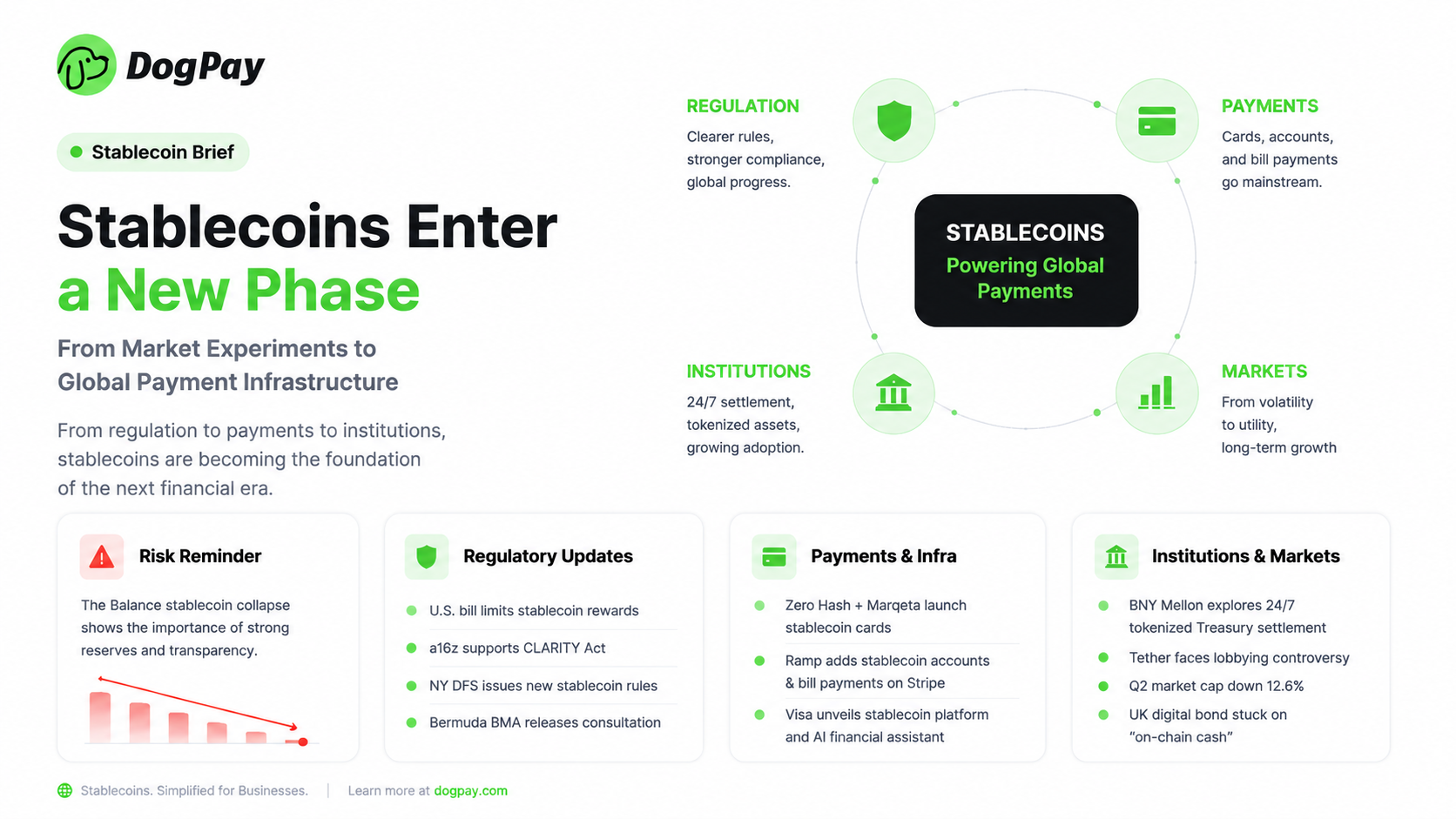
Stablecoins are moving deeper into mainstream finance, but the market is also being forced to answer harder questions. On July 23, 2026, the stablecoin news cycle showed both sides of the industry at once: a collapse that reminded users why reserves matter, a wave of regulatory activity, and a growing push from payment and infrastructure companies to make stablecoins usable in everyday business flows.
For DogPay, the message is clear. Stablecoins are not just a crypto asset category. They are becoming payment infrastructure. That means merchants, platforms, and payment providers need to think beyond speed and cost. They also need to evaluate transparency, redemption quality, compliance, user experience, and operational controls.
1. A Collapse Reminds the Market Why Reserves Matter
The reported collapse of Balance’s BLC stablecoin, which fell by more than 99% after its Bitcoin vault was drained, is a sharp warning for the market. The event highlights one of the most important distinctions in stablecoin design: a stablecoin is only as strong as the assets and controls behind it.
For users and merchants, the lesson is practical. A stablecoin should not be judged only by its market price during calm periods. Teams should ask how it is collateralized, whether reserves are liquid, who controls the reserve assets, how redemption works, and what happens when market stress arrives.
In payment scenarios, confidence is not optional. If a merchant accepts a stablecoin for checkout, payroll, settlement, or treasury movement, that merchant needs a high level of trust that the asset can hold value and be converted when needed.
2. Regulation Is Moving From Debate to Implementation
The policy environment is also accelerating. In the United States, lawmakers continue to debate how stablecoin issuers, rewards, market structure, and consumer protections should be handled. The discussion around stablecoin yield and rewards is especially important because it sits at the intersection of payments, banking, and securities law.
At the state level, New York’s financial regulator has moved quickly to align stablecoin oversight with the new federal direction created by the GENIUS Act. For licensed issuers and payment businesses, this signals that compliance will become more detailed, not less.
Outside the United States, Bermuda’s financial authority has opened consultation on stablecoin regulation. This matters because offshore financial centers often play an important role in digital asset company structures. As more jurisdictions define their rules, stablecoin businesses will face a more global compliance map.
For DogPay and other payment infrastructure providers, this is not a negative development. Clearer rules can make stablecoin payments safer for merchants and more credible for institutional users. The cost is that platforms must build stronger compliance, reporting, and risk-management processes from the beginning.
3. Payment Infrastructure Is Becoming the Next Battleground
While regulators focus on safety, payment companies are focusing on usability. Zero Hash and Marqeta have announced stablecoin-enabled card payment infrastructure, bringing crypto-funded spending closer to traditional card networks. Ramp has also expanded stablecoin-related capabilities on the Stripe stack, including accounts and bill payment functions for businesses.
These developments show that stablecoin adoption is no longer only about holding digital dollars on-chain. The real opportunity is connecting stablecoins to familiar payment moments: cards, invoices, bills, merchant checkout, subscriptions, and cross-border settlement.
Visa’s continued move into stablecoin infrastructure and AI-assisted financial experiences points in the same direction. Large payment networks are not treating stablecoins as a side experiment. They are exploring how tokenized money can become part of the next generation of financial workflows.
4. What This Means for Merchants
For merchants, stablecoin payments should be evaluated through a business lens. The question is not simply whether stablecoins are popular. The question is whether they can improve payment completion, settlement speed, geographic reach, and operational efficiency without adding unacceptable risk.
A strong stablecoin payment strategy should include four checks:
Asset quality: Which stablecoins are supported, and what is known about their reserves, redemption process, and issuer oversight?
Checkout clarity: Can users clearly understand the amount, network, payment status, and order expiration time?
Operational control: Can the merchant track unpaid, confirming, expired, late, or mismatched payments from one dashboard?
Compliance readiness: Does the payment provider support the controls needed for risk monitoring, reporting, and jurisdiction-specific requirements?
5. DogPay’s View: Stablecoins Need Trustworthy Rails
The stablecoin market is entering a more mature phase. The winners will not be the projects that only promise speed. They will be the platforms that combine speed with trust, usability, and operational reliability.
DogPay’s role is to help merchants turn stablecoins into practical payment rails. That means building flows that feel simple for users and manageable for business teams. A merchant should be able to accept a stablecoin payment, understand the order status, handle exceptions, and reconcile transactions without needing to manage every technical detail manually.
As regulatory frameworks become clearer and payment infrastructure improves, stablecoins can become a more useful layer for global commerce. But the Balance collapse is a reminder that adoption must be selective and disciplined. Infrastructure matters. Asset quality matters. User experience matters.
Final Thoughts
July 23, 2026 captured the stablecoin industry in transition. Risk events exposed weak designs. Regulators pushed toward clearer standards. Payment companies moved stablecoins closer to everyday business use.
For merchants, this is the right moment to study stablecoin payments carefully. Start with a measurable use case, choose reliable assets and infrastructure, monitor operational data, and scale only when the payment experience proves itself. Stablecoins can improve global payments, but only when they are built on trustworthy rails.